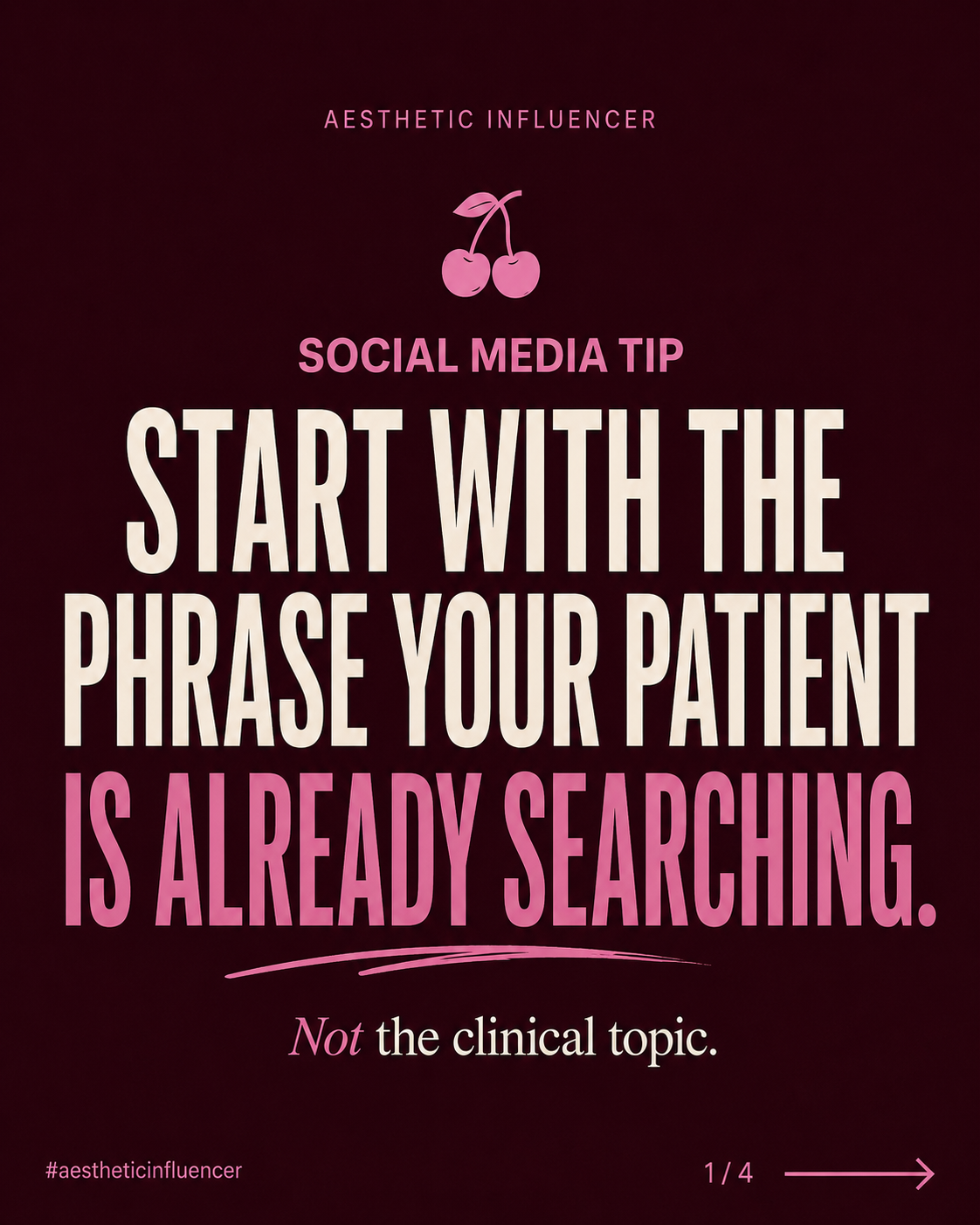
Start With the Phrase Your Patient Is Already Searching
One of the easiest ways to make educational content more effective is to stop starting with the clinical topic.
Providers naturally think in diagnoses, procedures, and treatment terminology. Patients usually don’t. That creates a small but important gap in social content because the provider may be talking about the right issue, but using language the patient would never think to search.
A dermatologist might naturally open a video with, “Let’s talk about hyperpigmentation.” A patient, on the other hand, is much more likely to search something like, “Why do my acne marks stay dark for months after the pimple is gone?” Those two phrases are describing the same concern, but only one sounds like the way the patient is actually thinking about it.
That matters because social platforms increasingly function like search engines. People are typing full questions into TikTok, Instagram, YouTube, and Google, looking for explanations in the same language they use when they are confused, curious, or trying to decide whether something is worth asking a provider about.
The shift is simple: move from the clinical topic to the patient question.
That does not mean oversimplifying your expertise. It means leading with language the patient already understands and then using your expertise to answer it. Instead of starting with “Let’s talk about melasma,” you might start with “Why does the discoloration on my face keep coming back even after I treat it?” Instead of “Let’s discuss skin laxity,” try “Why does my lower face look heavier even though I haven’t gained weight?”
The clinical terminology can still be part of the content. It just does not always need to be the entry point.
Once you identify the patient-language version of the topic, use that phrasing consistently throughout the post. Say it on camera. Put it on screen. Then use the same natural terminology in the caption. You do not have to repeat the exact sentence three times, but the language should stay aligned so both the patient and the platform clearly understand what the content is about.
This is not about keyword stuffing. It is about reducing the amount of translation your audience has to do.
When a provider says “post-inflammatory hyperpigmentation,” a patient may need to figure out whether that means the dark mark left behind after a breakout. When the content starts with the question they already have, that extra step disappears. The content becomes easier to understand, easier to find, and more immediately relevant.
A simple exercise for your next content day is to write down the clinical topic you plan to film, then ask yourself: what would my patient type into the search bar if they did not know the name for this?
That question will often give you the stronger hook.
You can also look at your comments, DMs, consultation questions, FAQs, and even the wording patients use in person. They are already telling you how they describe the problem. You do not need to invent that language from scratch.
Your expertise should still lead the content. But the entry point should feel familiar to the person you want to reach.
Patient language first. Clinical expertise second.
Don’t make people translate your expertise into their problem. Meet them at the search bar.